Sensory Multi-Purpose Rooms
Status: in development. Equipment specification and room program complete; concept renders only.
One room that refuses to be one thing. Controlled light, texture, sound and movement help a young child either settle or explore, and the same space does both across a day.
Two modes, one room
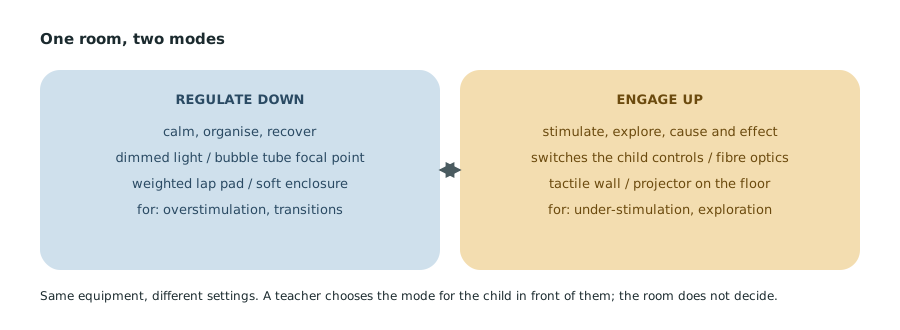
A sensory room (also called a multi-sensory environment or Snoezelen room) is a designed space that helps a child either:
- Regulate down. Calm, organise, and recover from overstimulation. Dimmed light, a bubble tube as a focal point, fibre optics safe to hold, weighted lap pads, slow floor projection.
- Engage up. Stimulate, explore, and build cause-and-effect understanding. Switches the child controls, tactile walls, motion-responsive projection, soft play and balance gear.
The concept dates to the late 1970s at the De Hartenberg Institute in the Netherlands, where therapists Jan Hulsegge and Ad Verheul coined Snoezelen from the Dutch snuffelen (to explore) and doezelen (to relax). (EBSCO Research Starters) A well-designed room is modular: staff dim and soften it, or activate it, as the day requires.
What is in the room
| Equipment | Senses | Function |
|---|---|---|
| Bubble tube (illuminated water column) | Visual, auditory, tactile | Passive calming focal point |
| Fibre-optic light strands | Visual, tactile | Safe-to-hold soothing light play |
| Tactile and texture walls | Tactile | Active exploration, fine motor, cause and effect |
| Interactive floor and wall projection | Visual | Immersive, motion-responsive scenes, calming or active |
| Weighted blankets and lap pads | Proprioceptive (deep pressure) | Grounding and calming |
| Sound and vibroacoustic platforms | Auditory, vestibular | Music, rhythm, feeling the sound |
| Soft play, swings, balance gear | Vestibular, proprioceptive | Gross motor, sensory integration |
| Aroma diffusers | Olfactory | Mood and arousal modulation |
What the research shows
Emotional and social self-regulation is the developmental foundation for everything else a young child learns. This is where the evidence for sensory rooms is strongest.
- The effect carries beyond the door. Kaplan, Clopton & Kaplan (2006), Snoezelen multi-sensory environments: task engagement and generalization. PubMed 16122905. Not just better engagement during sessions but fewer challenging behaviours on the days that followed.
- Giving the child the controls deepens it. Unwin, Powell & Jones (2022), The use of Multi-Sensory Environments with autistic children: Exploring the effect of having control of sensory changes. PubMed 34693744. When autistic children aged 4 to 12 operated the equipment themselves, they paid more attention, showed fewer repetitive behaviours and had lower overall activity. Child agency is built into the design.
- Children come back to the classroom able to focus. Pierce, Sensory Rooms: Increasing Preschool Students' Focus and Engagement in the Classroom. Northwestern College. NW Commons. A study specifically on preschoolers found sensory rooms increased focus, attention, positive behaviour and academic engagement.
- The strongest quantified result comes from neurodiverse children. Evaluating the Efficacy of Combining Sensory Room and Conventional Therapies for Lebanese Children With Autism: A 10-Year Retrospective Study. PMC11496388. 548 children; adding sensory room therapy to conventional therapy raised scores on a parent-completed improvement questionnaire from a mean of 34.1 to 41.7 (p < 0.001), while the conventional-only group showed no significant improvement.
Beyond regulation. Across the research and practice literature, sensory rooms touch cognition and problem solving, language (real deployments report children using more language when they feel safe, and previously nonverbal children beginning to speak), motor planning and sensory integration, and stress regulation.
Inclusion. About 1 in 31 U.S. children is identified with autism and roughly 1 in 6 has a developmental disability (CDC). A regulation-positive room lets a programme confidently enrol families most conventional settings are not equipped for, while every other child uses the same room.
Where the technology fits
- Interactive projection, deployment-ready. Sensor-driven floor and wall projection creates immersive, motion-responsive scenes with no screen and no headset. For children under five, it is the most age-appropriate immersive technology available.
- Biofeedback-style calming. Guided breathing and biofeedback approaches lower anxiety and heart rate in studies (systematic review and meta-analysis, 2022). A practical near-term calming feature.
- Data-informed adjustment. Engagement signals from the room feed the same record teachers already read, so the programme and the environment adapt to what each child and each class actually needs. Data path: How the data path works.
- Headset VR as a forward path. Emerging research points to a credible trajectory. We present it honestly as a future upgrade, not yet validated for under-fives, and lead with the proven screen-free tools today.
Safety and supervision
Following the national Caring for Our Children standards used in licensed care (National Resource Center), equipment is age-segregated, kept free of small parts that fail the CPSC choking-hazard test for children under three, and used only under continuous adult supervision at required ratios. Infant and toddler use emphasises fixed, enclosed, choke-safe elements: bubble tube, guarded fibre optics, projection, weighted lap pads. Loose tactile materials are reserved for older, supervised groups. Equipment is specified to CPSC and ASTM standards.
Proven in real facilities
- Stockton Elementary, Chicago. About 500 students, about 100 with special needs. After a Snoezelen room was installed, passive students became active explorers, hyperactive children calmed and nonverbal children began speaking. Within a year children were requesting sessions themselves. (source)
- Sweetwater County School District #2, Wyoming. District-wide multi-sensory programme tailored by age and ability. (source)
- Miami Children's Museum. Dedicated multi-sensory room and Sensory-Friendly Saturdays. (source)
- Cincinnati Children's Hospital. Clinical sensory-processing therapy spaces, a hospital-grade reference point. (source)
A 2025 systematic review (PubMed 40087858) found the research base still maturing and variable in quality, with no clinical guidelines yet established. The defensible position, and the only one we take, is that a sensory room is a low-risk, well-tolerated, inclusive support with a growing positive evidence base. It is not a clinical treatment and we make no claim beyond that.
The strongest numbers above come from neurodiverse populations; the benefit to every child rests on the broader inclusion and practice literature. The 2024 anger-hostility study sometimes cited for sensory rooms was conducted with an older population, not young children, and is not used here as early-childhood evidence.
Sources
- EBSCO Research Starters, Snoezelen / controlled multisensory environment. https://www.ebsco.com/research-starters/consumer-health/snoezelen-or-controlled-multisensory-environment-mse
- Kaplan, Clopton & Kaplan 2006. https://pubmed.ncbi.nlm.nih.gov/16122905/
- Unwin, Powell & Jones 2022. https://pubmed.ncbi.nlm.nih.gov/34693744/
- 2025 systematic review, multisensory environments in ASD. https://pubmed.ncbi.nlm.nih.gov/40087858/
- Ten-year retrospective study, 548 children. https://www.ncbi.nlm.nih.gov/pmc/articles/PMC11496388/
- Pierce, Northwestern College. https://nwcommons.nwciowa.edu/education_masters/432/
- VR biofeedback interventions for anxiety, 2022. https://pubmed.ncbi.nlm.nih.gov/34989862/
- CDC autism prevalence data. https://www.cdc.gov/autism/data-research/index.html
- Stockton Elementary School case. https://snoezelen.info/success-stories/stockton-elementary-school/
- Sweetwater County School District #2. https://www.swcsd2.org/page/snoezelen-a-multi-sensory-experience
- Miami Children's Museum. https://www.miamichildrensmuseum.org/sensory-friendly-saturdays
- Cincinnati Children's. https://www.cincinnatichildrens.org/service/o/ot-pt/specialized-programs
- Caring for Our Children, National Resource Center. https://nrckids.org/