Learning frameworks
Every AI suggestion an adult sees on the platform is grounded in a named research construct with a zone-of-proximal-development position. This page is the list. It is the same list the parent app's "Our approach" screen shows, kept here so a teacher, coach, or state reviewer can check the source.
Scarborough's Reading Rope
For decades reading was treated as one ability. It is two, braided together. Scarborough (2001) is the field-standard picture of how they grow. Reading Rockets overview.
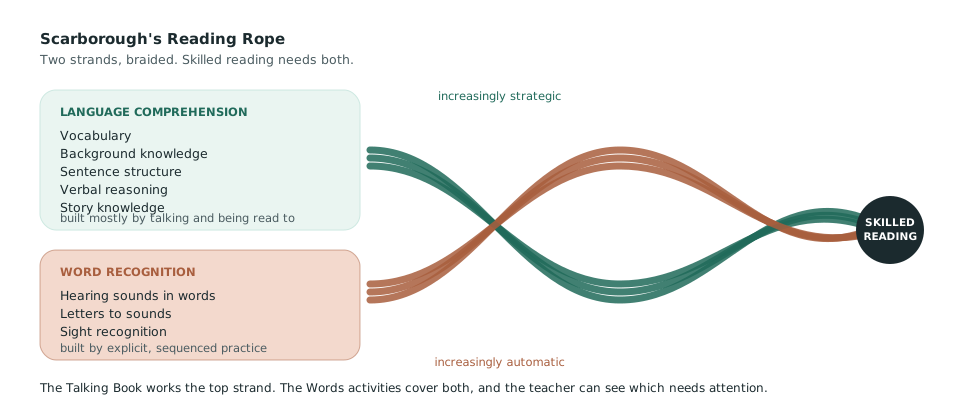
| Strand | What it is | How it is built |
|---|---|---|
| Language comprehension | Vocabulary, background knowledge, how sentences work, reasoning about a story | Mostly by talking and being read to |
| Word recognition | Hearing the sounds inside words, matching letters to sounds, recognising whole words on sight | Explicit, sequenced practice |
The Words activities cover both strands; the teacher can see which one needs attention. The Talking Book works the comprehension strand.
The sound ladder
Before children read, they learn to hear smaller and smaller parts of spoken language. One rung at a time; skipping ahead is one of the strongest predictors of later reading difficulty. National Early Literacy Panel (2008), Developing Early Literacy (NICHD record).
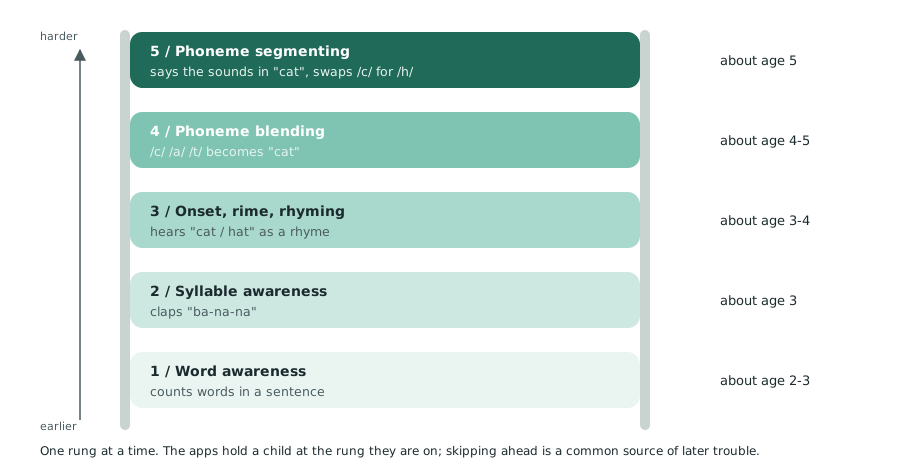
| Rung | Skill | Example | About age |
|---|---|---|---|
| 1 | Word awareness | Counts words in a sentence | 2 to 3 |
| 2 | Syllable awareness | Claps "ba-na-na" | 3 |
| 3 | Onset, rime and rhyming | Hears "cat / hat" as a rhyme | 3 to 4 |
| 4 | Phoneme blending | /c/ /a/ /t/ becomes "cat" | 4 to 5 |
| 5 | Phoneme segmenting | Says the sounds in "cat", swaps /c/ for /h/ | 5 |
Overview: Reading Rockets, phonological and phonemic awareness.
Clements & Sarama learning trajectories
Children learn early maths in a known order. First "one, two, three" without meaning, then touching each object, then understanding that the last word names how many. Clements and Sarama's learning trajectories are the most-studied developmental progressions in early maths. LearningTrajectories.org. The Count activities track where the child is and nudge one rung ahead, never two.
The five counting principles
"Counting" is not one skill. It is five. Gelman & Gallistel (1978), The Child's Understanding of Number. Harvard University Press.
| Principle | In plain words |
|---|---|
| One-to-one | One number for each thing |
| Stable order | Always 1, 2, 3, 4, 5 |
| Cardinality | The last number is how many |
| Abstraction | You can count anything |
| Order irrelevance | Start anywhere, same total |
If a child can recite numbers but does not know the last one tells you how many, that is a cardinality gap, not a counting gap, and it needs different practice. The teacher is told exactly which principle to coach.
Vygotsky's zone of proximal development
The space between "can do alone" and "too hard." Every activity the system suggests sits in it, and every suggestion is labelled so the teacher can see why it was offered. Overview.
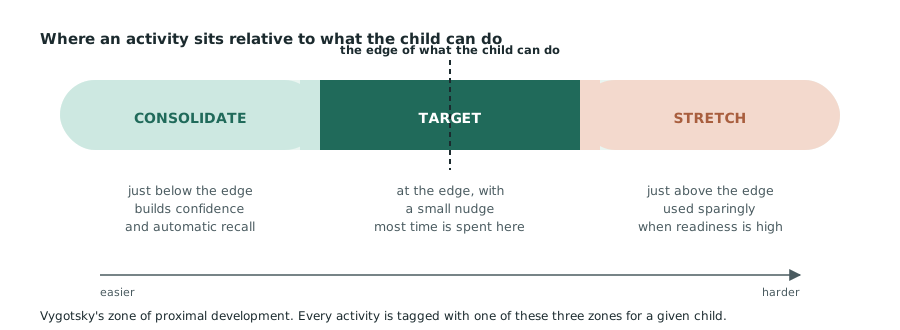
| Zone | Where it sits |
|---|---|
| Consolidate | Just below the edge. Builds confidence and automatic recall |
| Target | At the edge of what the child can do with a small nudge |
| Stretch | Just above the edge. Used sparingly, when readiness is high |
What the AI does, and never does
For children from birth to five, an AI should never be positioned as a chatbot, companion, or emotional bond. UNICEF's Policy guidance on AI for children (2021) is the reference. On the platform the AI sits in the background as a coach for the teacher. The child never talks to it.
| Does | Never does |
|---|---|
| Listens for hesitation and pronunciation during an activity to gauge confidence | Chat with the child. No open conversation, ever |
| Maps each child's spot on a learning trajectory | Act as a friend, companion, or emotional support |
| Suggests the next activity to the teacher, never to the child | Generate freeform stories or content for the child |
| Sends the teacher a one-paragraph "why" with every suggestion | Listen when an activity is not on screen |
| Stays inside the school's environment. Not used to train models | Replace the teacher's judgment |
Standards the platform maps to
- Head Start Early Learning Outcomes Framework, birth to five
- NAEYC Developmentally Appropriate Practice, 2022 position statement
- Web Content Accessibility Guidelines 2.2, W3C recommendation
These are frameworks, not outcomes. They tell us what to measure and in what order; they do not by themselves prove that the platform improves anything. Outcome evidence comes from the pilot and will be published on this site when it exists.
Sources
- Scarborough 2001, via Reading Rockets. https://www.readingrockets.org/topics/about-reading/articles/scarboroughs-reading-rope-groundbreaking-infographic
- National Early Literacy Panel 2008, NICHD. https://www.nichd.nih.gov/publications/product/346
- Reading Rockets, phonological and phonemic awareness. https://www.readingrockets.org/topics/phonological-and-phonemic-awareness
- Clements & Sarama, LearningTrajectories.org. https://www.learningtrajectories.org/
- Gelman & Gallistel 1978, Harvard University Press. https://www.hup.harvard.edu/books/9780674116375
- Vygotsky, Mind in Society 1978, ZPD overview. https://www.simplypsychology.org/zone-of-proximal-development.html
- UNICEF 2021. https://www.unicef.org/innocenti/reports/policy-guidance-ai-children
- Head Start ELOF. https://headstart.gov/interactive-head-start-early-learning-outcomes-framework-ages-birth-five
- NAEYC DAP 2022. https://www.naeyc.org/resources/position-statements/dap
- W3C WCAG 2.2. https://www.w3.org/TR/WCAG22/